Hotel & Houseboat Website Design in Kashmir
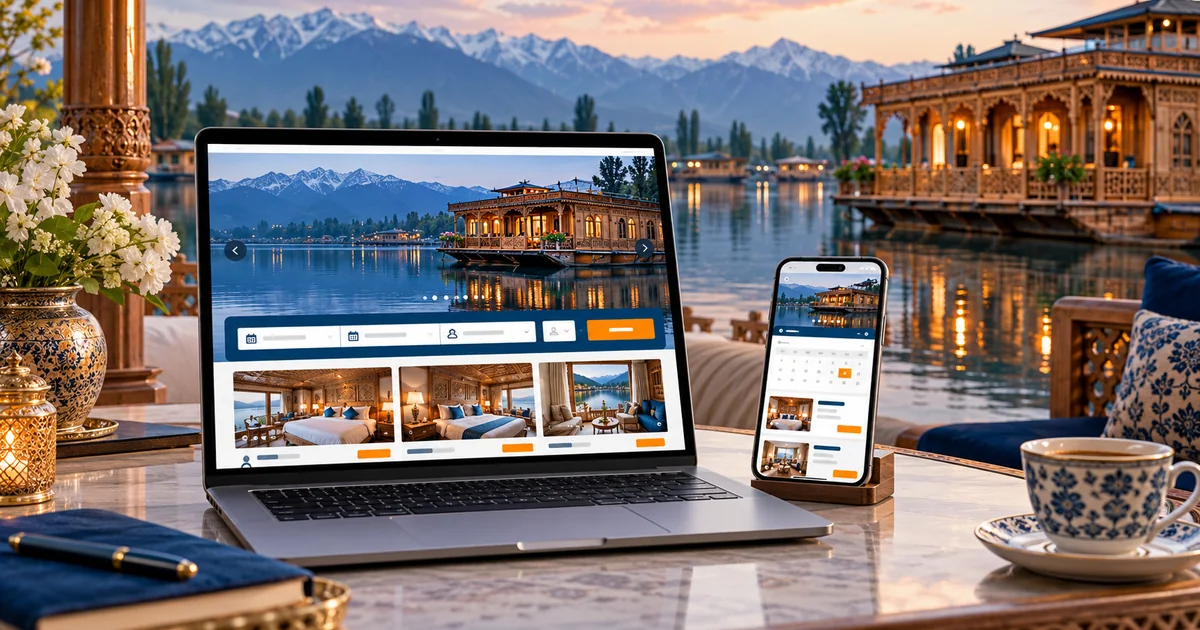
A hospitality website should let a guest picture the stay, compare room options and understand how a booking is confirmed. This guide is for hotels, guesthouses and houseboat operators in Kashmir who want direct enquiries without misleading guests about live availability.
- What guests look for before they book a stay
- How to write room and property pages that answer real questions
- The difference between a booking enquiry and live availability
- When a booking engine or channel manager integration is worth the cost
In this guide
- What guests need before booking
- Room and property pages that answer questions
- Photographs, amenities and location information
- Booking enquiry versus live availability
- Rates, policies and guest communication
- Connecting a booking engine or channel manager
- Mobile performance and destination content
- Scope, integrations and ongoing costs
- Prepare your project brief
- Frequently asked questions
What guests need before booking
Guests choose accommodation by matching a property to a trip: location, room type, capacity, budget and atmosphere. On a houseboat or a small hotel, they also want reassurance — who runs the property, what an actual stay looks like, and how they will be received on arrival.
A useful website answers those questions in one pass. Show the property clearly, list each room type with capacity and amenities, explain where it is and how to reach it, and make one booking action obvious on every page.
For seasonal destinations such as Srinagar, Gulmarg or Pahalgam, guests often shortlist several properties at once. A site that answers quickly in clear language has a real advantage over one that only shows a phone number.
Room and property pages that answer questions
Each room category should have its own page with real details: maximum occupancy, bed configuration, whether an extra bed is possible, bathroom arrangements, heating or cooling, Wi-Fi and the view or location within the property.
- Room categories with accurate capacity and amenities
- Houseboat-specific information where relevant: number of bedrooms, shared or private facilities, deck access and meals
- Property-level details: dining, parking, check-in time and accessibility notes
- Location details with landmarks and travel times from the airport, railway station or bus stand
Use only details the owner has confirmed. Invented amenities create complaints at check-in, which cost more than the booking is worth.
Photographs, amenities and location information
Photographs are the strongest selling asset a property has, and also the easiest place to erode trust. Use current, well-lit photographs of the actual rooms, bathrooms, views and common areas. Do not mix in images of a neighbouring property or an unrelated houseboat.
Organise photographs by room type and property area so guests can see exactly what they are considering. Compress images properly so pages load quickly on mobile networks — a slow gallery loses guests before the first photo opens.
Location information should be practical: nearby landmarks, distance to Dal Lake gates or the main market, and pickup options the property offers. Accurate arrival guidance reduces no-shows and late-night coordination calls.
Booking enquiry versus live availability
This decision shapes both the guest experience and the front desk workload. A booking enquiry is a request; real-time availability means the calendar shown is the calendar that will honour the booking.
| Option | Best for | What it requires |
|---|---|---|
| WhatsApp enquiry | Small guesthouses and family-run houseboats. | A monitored phone and quick replies during the day. |
| Booking request form | Properties with an office or manager handling confirmations. | Dates, party size, room type and a documented response process. |
| Connected booking engine | Hotels with volume across multiple channels. | Subscription fees, inventory discipline and staff training. |
A calendar graphic that is not connected to real inventory is worse than no calendar at all. Show availability honestly or collect requests and confirm personally.
Rates, policies and guest communication
Publish the rate structure you are willing to honour: starting rates by season, what is included, and any mandatory charges. If rates vary, explain how instead of leaving guests to guess.
State the policies plainly — check-in and check-out times, cancellation terms, payment methods and what happens with early check-in requests. Guests who understand the terms arrive with the right expectations and complain less.
Provide the fastest contact channel and the hours it is monitored. For many properties, a WhatsApp number with clear response hours outperforms an email address nobody checks.
Connecting a booking engine or channel manager
If the property already sells on OTAs and wants direct bookings, a booking engine can sync availability across channels. That convenience comes with recurring subscription costs and an operational discipline: rooms must be blocked and released correctly, or the property ends up overbooked on its own website.
The website work here is integration: embedding the engine, passing dates and guest details cleanly, and keeping the direct-booking path visible. The engine's own pricing, contract and support terms sit with the provider, not with the website build.
For a small property without channel pressure, a well-run request process is often more profitable than paying monthly fees for capacity it does not need.
Mobile performance and destination content
Most travel searches happen on a phone, sometimes on a weak network. Fast images, a lightweight booking form and tap-to-call are more valuable than decorative animation.
Destination content — what to see, how many days to plan, local travel practicalities — keeps the site useful beyond the booking decision and gives guests a reason to return. Write it from the property's own knowledge of the area and update it seasonally.
A family compares two houseboats on Dal Lake. The one that shows bedroom photos, explains shared meals, lists a Lake View gate for pickups and offers a form asking dates, guests and meal preference receives a clear enquiry the operator can answer in one message. The other site shows a phone number and three landscape photos.
Scope, integrations and ongoing costs
Hospitality website scope depends on the number of room types, whether direct booking is integrated and how much destination content the property maintains.
Core build
- Property homepage with location, atmosphere and booking action
- Room and houseboat category pages with capacity and amenities
- Organised photo galleries per room and area
- Booking request form with dates, party size and contact details
- Rates overview, policies and arrival information
Optional integrations
- Booking engine integration with live availability
- Channel manager connection for OTA synchronisation
- Multilingual content for international guests
- Seasonal offers or packages pages
Ongoing running costs to plan for
- Hosting and domain renewal
- Booking engine or channel manager subscription fees
- Seasonal rate and content updates
- Photo refreshes and review monitoring
Want an honest view of which of these you actually need? Send us your requirements and we will scope it with you. You can also read our current pricing guide before you decide.
Prepare your project brief
A hospitality brief is mostly property facts and photographs. Gather these before development so the content is accurate from day one.
- Room and houseboat categories with accurate capacity and amenities
- Current, high-quality photographs of every room and key area
- Policies for check-in, cancellation, payment and extra beds
- Location details, landmarks and pickup options the property offers
- The person who will answer booking enquiries, and response hours
- Whether an OTA or booking engine is used today, and its contract terms
- Any meal, activity or transport service the property genuinely provides
Frequently asked questions
Plan your hospitality website
Tell us about your property, rooms and how bookings are confirmed today. We will suggest a scope that fits how you actually operate.
Related industry guides
Travel Agency & Tour Operator Website Development
How tour operators should structure package pages, day-by-day itineraries and custom-trip enquiries so quotations can be prepared accurately.
Restaurant & Café Website Design
How restaurants and cafés should present menus, timings, locations and reservations so diners can act in seconds, without heavy integrations they do not need.
E-Commerce Websites for Kashmir Brands
How Kashmir retailers, craft sellers and product brands should scope an online store around catalogue clarity, payments, delivery and ongoing running costs.
Looking for the broader picture? See our website design in Srinagar page, or explore Web Development services.